|
|
|
PRODUCTS MANUFACTURED BY:
|
|
|
|
|
|
|
|
|
|
|
 |
|
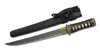
| Hanwei Practical Plus Tanto (SH2259) |
Points: 8

|
The Practical Plus Tanto (SH2259) provides a very economical cutting tanto, but uses more traditional fittings and construction methods. The blade is hand-forged high-carbon steel and differentially tempered using a traditional claying method (HRC 60 edge, HRC 40 spine) with a medium (chu) kissaki. The temper line (hamon) is evident and prominent. The Practical Plus Tanto uses a flat black saya and a black Japanese cotton sageo. The tsuka has genuine ray skin (same) and the tsuka-ito is black synthetic leather for better gripping qualities. The antiqued fittings on this set are decorated in a Japanese dogwood motif with a beautiful antiqued black sunburst tsuba. A great econimcal tanto with fantastic quality.
High Carbon Blade
Authentic Design
Sold Out
|
|
|
|
|
|
 |
|
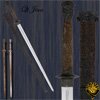
| Hanwei Qi Jian (SH2295) |
Points: 40
|
From the master swordsmiths of the Hanwei forge comes the Qi Jian, a re-creation of an ancient design that utilized one-piece forging. The entire sword, from pommel to tip, has been forged from a single billet of steel. This forging technique provides unparalleled strength and balance while exhibiting a clear, bell-like tone when lightly struck.
The sword's name originates with the Qi nation, one of the many warring states that eventually formed modern China. Legend has it that Feng-Xuan, one of the Qi people and a central character in a well known folk tale, possessed such a one piece sword and would use its ringing quality to accompany his singing.
The sword's grip is rayskin wrapped, a feature matched by the wrap on the throat of the scabbard, making for a stunningly beautiful presentation.
Sold Out
|
|
|
|
|
|
 |
|
| Hanwei Qing Sword (SH2007) |
Points: 65
|
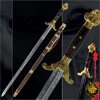
The traditional perception of the Taiji sword becomes very apparent in the Qing Sword. The last of the Chinese Dynasties, the Qing (Ching) Dynasty was overthrown by rebellion as late as 1911, by which time the Taiji sword had completed its evolution into the "modern" form. The sword is crafted around a beautifully pattern-welded K120C blade with a flattened diamond section. The guard and pommel are constructed of gilded steel featuring a flying bat design, which in Chinese ideology symbolizes luck. The scabbard decorations are in gilded brass and the intricate knot-work of the tassel is art in its own right.
Recreated by the craftsmen of CAS Hanwei from the swords of the Lords of the great dynasties, these Chinese Gongfu swords represent the pinnacle of the sword maker's art, vividly illustrating the skills and creativity of the smiths of Imperial China.
Sold Out
|
|
|
|
|
|
 |
|
| Hanwei QuanDong Folder (KH2026) |
Points: 5
|
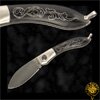
Silver inlaid buffalo horn is the handle material of choice for Hanwei's Quandong Folder. The form of the folder originated many generations ago in the Quandong (or Canton)Province, but the button lock, from designer Paul Chen, is strictly a modern twist. The Quandong represents influences of nature in the design with its egg plant shaped handle and bamboo leaf shaped blade. A truly interesting piece for the collector and knife enthusiast.
Sold Out
|
|
|
|
|
|
 |
|
| Hanwei Raptor Katana, Moroha Zukuri (SH2413) |
Points: 30

|
Forged in the Kissaki Moro Ha Zukuri style, the blade design of the Moroha Zukuri Katana is based on a Tachi blade believed to have been forged around 800 AD by the smith Amakuni, though many similar blades have been produced in later Japanese history.
Sold Out
|
|
|
|
|
|
 |
|
| Hanwei Raptor Katana, Nambokucho Zukuri (SH2416) |
Points: 30
|
The Nanbochuko period in Japanese history (the later part of the 14th. century) encompassed sixty years of internal conflict in Japan, which spawned a demand for more and bigger sword blades than ever produced previously.
Sold Out
|
|
|
|
|
|
 |
|
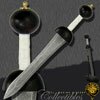
| Hanwei Roman Letter Opener (MH2284) |
Points: 2
|
The Roman Gladius was the sword that built the fabulous Roman Empire, earning its reputation in the hands of Legionnaires on the battlefield and Gladiators in the arena. Short and double-edged, the Gladius was unmatched in the close-quarters combat for which the Romans were renowned.
Sold Out
|
|
|
|
|
|
 |
|
| Hanwei Sakura Arrowhead (XH2223) |
Points: 2
|
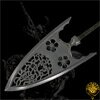
Our Japanese arrowheads (yanone) are faithfully reproduced from originals in museum collections. Some yanone were strictly utilitarian while others, like most of these examples, were beautifully pierced and decorated and used primarily for presentations and temple offerings. Most pieces fall into one of several broad groupings. The Torii, Dharma, Monkey Moon and Bamboo Butterfly fall into "Willowleaf" pattern, while the Swimming Dragon, Watakusi, Sakura and Fudo follow the Flesh Terror (Barbed) profile. The Karimata, Dragon Cloud, Boar's Eye and Tiger Dragon are crafted in what is known as the "Rope Cutter" style, though it is more likely that this profile was used for hunting big game rather than cutting ropes. These arrowheads, either singly or in groups, are outstanding collectibles and conversation pieces. Also available is the arrowhead display stand (OH2235) to showcase up to 6 arrowheads.
Sold Out
|
|
|
|
|
|
 |
|
| Hanwei Samurai Blade Display (OH2154) |
Points: 35
|
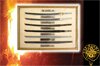
This is an elegant display articulating the highly skilled process of forging and polishing a high carbon steel Katana blade. Each step in the process is clearly displayed and explained, using smaller (18") versions of Katana blades that have undergone exactly the same processes as full-sized blades. This display is both aesthetically pleasing and highly educational.
Sold Out
|
|
|
|
|
|
 |
|
| Hanwei Shaolin Jie Dao (SH2440) |
Points: 8
|
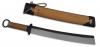
The Jie Dao, which may vary greatly in size, is traditionally used by Shaolin monks not as a weapon (which is forbidden) but for domestic purposes, including shaving. When traveling on foot, the Jie Dao may be used to clear a path in the forest or to gather firewood. The “Jie” in Jie Dao means “abstain”, and Jie Dao translates as “the sword of abstention from killing”. This explains the deliberate lack of a sharp point and ascribes spiritual as well as functional value. The best known legend involving the Jie Dao tells of Huike, the successor to Bhodidharma, who cut off his left arm with a Jie Dao in order to demonstrate his sincerity to Dharma.
Sold Out
|
|
|
|
|
|
 |
|
| Hanwei Shinto Blade in Shirasaya (SH1094) |
Points: 30
|
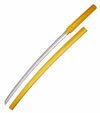
For those wishing to build a custom Samurai sword on a Hanwei blade, we offer in Shirasaya the blade used in the Shinto Katana, which has met the cutting demands of users worldwide. It is forged and differentially tempered in the traditional fashion, with a distinctive hamon, and is pre-fitted with its habaki. The hardwood Shirasaya is solidly made to provide safe storage of the blade.
Hand forged high-carbon steel blade
Differentially tempered
Pre-fitted Habaki
Sold Out
|
|
|
|
|
|
 |
|
| Hanwei Shinto Iaito (SH6004IGG) |
Points: 30
|
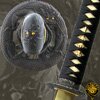
The Shinto Iaito Katana has a hand forged unsharpened stainless steel blade. The stainless steel blade not only provides a maintenance free blade but more importantly provides the correct weight and balance needed for the rigors of repetitive drawing and sword motion practice. The blade features a deep Bo-Hi to provide audible feedback when the sword is swung.
The Saya has been constructed from hard wood and finished in a deep black lacquer with a black Japanese cotton sageo.
A finely rendered dragon, detailed in gold, with true front and back detail, forms the black iron Tsuba.
Sold Out
|
|
|
|
|
|
 |
|
| Hanwei Shuihi Tachi (SH2185) |
Points: 50
|
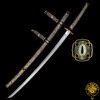
This masterful production by Hanwei combines the elements of one of the four most popular Chinese classic novels, written in the 14th Century, with an elegantly crafted and superbly decorated Tachi.
Shui Hu Chuan (Water Margin Chronicles), translated in 1933 by Nobel Laureate Pearl S. Buck as "All Men are Brothers" is a truly epic tale of a band of outlaws who, in Robin Hood fashion, attempt to overthrow a corrupt government in the name of the Emperor. Our Tachi tells the story in a series of exquisitely detailed bas-relief panels on the sides of the Tsuka and Saya, held in place by retainers that are themselves lavishly decorated in a Chrysanthemum motif.
The blade of the Tachi is no less outstanding, forged and folded from Swedish Powder Steel, with a hamon displaying elements of both notare and gunome, it is in itself a work of art.
Sold Out
|
|
|
|
|
|
|
Tags:
swords, sword, katana, wakizashi, tanto, japanese sword, medieval sword, viking sword, japanese swords, medieval swords, viking swords, knife, knives, saber, armour, movie swords, movie replicas, martial arts, sporting goods, sporting equipment,
|



 - New items
 - Discounted items
 - Add to favorites