|
|
|
PRODUCTS MANUFACTURED BY:
|
|
|
|
|
|
|
|
|
|
|
 |
|
| Windlass French Napoleonic Briquet Short Sword (501867) |
Points: 10


|
This short saber was introduced in 1767, preceding the French Revolution, as a replacement for heavier and cumbersome swords like the fusilier’s ēpēe. It was instantly derided for its modest dimensions and nicknamed “Briquet” (”fire lighter”) and the name stuck and became official in 1806.
|
|
|
|
|
|
 |
|
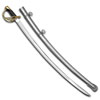
| Windlass Heavy Cavalry Saber 1840 (501150s) |
Points: 10
|
This historically accurate saber was well known as the “Wrist Breaker”. The model 1840 Cavalry Saber has a three branch brass guard, brass wire wrapped black leather grip.
|
|
|
|
|
|
 |
|
| Windlass Musketeer Rapier Sword 1590 |
Points: 20
|
Our Musketeer rapier is fashioned after those circa 1590. The basket hilt is ambidextrous and a very effective mix of both the cup-hilt and swept-hilt styles. The grip is wood wrapped with twisted wire and the parts of the hilt are plated with gleaming nickel silver.
|
|
|
|
|
|
 |
|
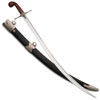
| Windlass Persian Scimitar 1700 (501899s) |
Points: 10
|
The original scimitar was called a shamshir, (which meant "lion's tail") and had a deeply curved blade that was almost a half circle. Developed in Persia, this type of blade was effective for draw cuts, but other than that, of limited utility. This caused the blade to shift its shape into a more useful version, which we have chosen to copy.
|
|
|
|
|
|
 |
|
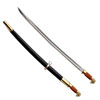
| Windlass Russian Shasqua |
Points: 12
|
Known originally as a Cossack cavalry weapon, this Russian Shasqua was later adopted as the official officer’s sword of the Soviet Union. The single‐edged, moderately curved blade is forged from tempered high‐carbon steel for strength.
|
|
|
|
|
|
 |
|
| Windlass Saint Michael Sword (501896) |
Points: 10
|
This falchion has a sharp, broad, single‐edged, wide blade with a gentle curve toward the tip. Steel crossguard shaped into an elegant, almost S‐curving quillon on one side, while the other quillon is a simpler, shorter projection.
|
|
|
|
|
|
 |
|
| Windlass Signature Series Sword of Roven 1400 (501895) |
Points: 12
|
This medieval sword has considerable length, providing both substantial reach and striking power. The Sword of Roven has a spring tempered, sharp blade made of 1075 high-carbon steel. The hilt features a wooden core with a cord wrap, finished in brown-black leather, while the guard and pommel are made of steel.
|
|
|
|
|
|
 |
|
| Windlass Signature Series Towton Sword 1350-1400 (501893) |
Points: 15
|
In 1461, Edward IV led a Yorkist army against King Henry VI’s Lancastrians at Towton. A snowstorm favored the Yorkist archers, forcing 20,000 Lancastrians to charge downhill. Thousands died in one of England’s bloodiest battles. Named for that clash, our sword has a sharp, tapered blade, fine balance, and well-tempered steel.
|
|
|
|
|
|
 |
|
| Windlass Steelcraft Falcata |
Points: 12
|
Circa 200 BC
The Celt-Iberians of Roman times were justly famed for their weapons, such as the Falcata; one of the most devastating swords ever made! The inward curving blade delivered a tremendous blow and could split both shield and helmet. Considered to be of Greek, or possibly Etruscan origin, this sword spread into Southern Russia and also Spain. It was in Spanish hands that it was most feared by the Romans. The blade is made from high carbon steel. The handle is solid brass. Comes with brown leather scabbard.
500062 - not sharp
500062s - sharpened
|
|
|
|
|
|
 |
|
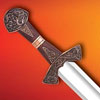
| Windlass The Suontaka Viking Sword |
Points: 12
|
Our stunning version of Suontaka Viking Sword features a highly detailed knot work pommel, guard, grip band and inserts. All have been lavishly plated in rich copper. The tough high carbon steel blade has a full tang and is fully tempered, then peened over the pommel.
|
|
|
|
|
|
 |
|
| Windlass Viking Sword of Baldur |
Points: 15
|
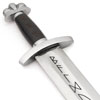
The blade is etched with runes that roughly can be translated as the spelling of "Baldur".
The leather sheath (with integral belt) is covered with a layer of black suede that is adorned with top grain lace, throat, and chape. The throat and chape bear a Viking symbol for the sun, as Baldur was known as a shining light to all who knew him.
|
|
|
|
|
|
 |
|
| WWI M1916 Avenger French Fighting Knife Windlass (420023) |
Points: 5
|
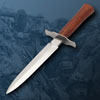
The "Le Vengeur de 1870" dagger, often called "The Avenger of 1870," emerged from a desire for retribution following France's defeat by Prussia in 1870. Its straightforward and functional design ensured its continued use through World War II, highlighting the enduring need for close-quarters combat weapons in any army, even in the age of firearms.
|
|
|
|
|
|
|
Tags:
swords, sword, katana, wakizashi, tanto, japanese sword, medieval sword, viking sword, japanese swords, medieval swords, viking swords, knife, knives, saber, armour, movie swords, movie replicas, martial arts, sporting goods, sporting equipment,
|



 - Clearance sale
 - Discounted items
 - Add to favorites