|
|
|
 |
|
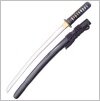
| Hanwei Miyamoto Musashi Wakizashi (SH1017) |
Points: 20
|
During the Muromachi period (1568-1603), the introduction of the pairing of the Katana (the curved sword) and Wakizashi was introduced. The Wakizashi, or the shorter companion blade to the Katana, was about 18 inches long. Only the warrior class - the Samurai - was allowed to wear the two swords, which remained a custom for the next several hundred years until abolished in the 19th century. This Wakizashi is the companion piece to the Musashi Miyamoto Katana (SH1016) with matching fittings and blade construction. Supplied with a protective cloth bag and traditional maintenance kit.
Hand forged high-carbon steel
Built for cutting
Traditional construction
|
|
|
|
|
|
 |
|
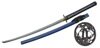
| Hanwei Golden Oriole Katana (SH1018) |
Points: 35

|
The deeply lacquered blue of the saya is repeated in the Japanese cotton tsuka-ito, and a mantis motif appears again on the kashira. Unmistakably of Hanwei quality, the sword's approx. 36 cm long tsuka provides a superb balance, allowing it to move very quickly and very freely. Every Katana comes with a custom-fit cloth bag for proper protection and a Japanese blade maintenance kit.
|
|
|
|
|
|
 |
|
|
|
|
 |
|
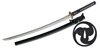
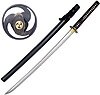
| Hanwei Great Wave - Tsunami Katana (SH5004) |
Points: 40
|
Each piece in the Great wave Series (SH5004, SH5002, & SH5022) is stylized with the renowned Tomoe motif. The tsuba, fuchi, & kashira are made of black iron and marked with the Tomoe crest (mon). The blades are hand-forged from T10 high-carbon steel and are differentially tempered using traditional claying methods. The temper line (hamon) is evident and prominent. Each piece has a deeply lacquered black saya with a one-piece brass habaki construction. Real ray skin (same) is used on the tsuka, and the tsuka-ito and sageo are made of premium woven Japanese black cotton. The katana and wakizashi are constructed with a large o-kissaki and are ideal for cutting exercises (tameshigiri). The handle on the tanto is an attractive ribbed buffalo horn.
High-carbon steel
Deeply lacquered black saya
Ideal for cutting exercises
|
|
|
|
|
|
 |
|
| Hanwei Great Wave - Tsunami Wakizashi (SH5002) |
Points: 30
|
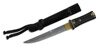
Each piece in the Great wave Series (SH5004, SH5002, & SH5022) is stylized with the renowned Tomoe motif. The tsuba, fuchi, & kashira are made of black iron and marked with the Tomoe crest (mon). The blades are hand-forged from T10 high-carbon steel and are differentially tempered using traditional claying methods. The temper line (hamon) is evident and prominent. Each piece has a deeply lacquered black saya with a one-piece brass habaki construction. Real ray skin (same) is used on the tsuka, and the tsuka-ito and sageo are made of premium woven Japanese black cotton. The katana and wakizashi are constructed with a large o-kissaki and are ideal for cutting exercises (tameshigiri). The handle on the tanto is an attractive ribbed buffalo horn.
High-carbon steel
Deeply lacquered black saya
Ideal for cutting exercises
|
|
|
|
|
|
 |
|
| Hanwei Great Wave - Tsunami Tanto (SH5022) |
Points: 20
|
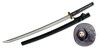
Each piece in the Great wave (SH5004, SH5002, & SH5022) has a hand-forged T10 high-carbon steel blade (nagasa) and is differentially tempered using a traditional claying method. The tsuba, fuchi, & kashira are made of black iron and marked with the Tomoe crest (mon). The temper lines (hamon) are evident and prominent. Each piece has a deeply lacquered black saya with a one-piece brass habaki construction. Real ray skin (same) is used on the tsuka, and the tsuka-ito and sageo are made of premium woven Japanese black cotton. The katana and wakizashi are constructed with a large o-kissaki and are ideal for cutting exercises (tameshigiri). The handle on the tanto is an attractive ribbed buffalo horn. A great set for those interested in the art of Kenjutsu.
High-carbon steel blade
Deeply lacquered black saya
Ribbed buffalo horn
|
|
|
|
|
|
 |
|
| Hanwei Wind & Thunder Katana (SH5001) |
Points: 35
|
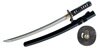
The Hanwei Wind and Thunder Katana is a Japanese sword built for martial artists who demand a blade capable of handling heavy target cutting. Its hand-forged T10 high-carbon steel blade is thicker and heavier than Hanwei's standard katana, making it well suited to tameshigiri and batto-jutsu training. Traditional fittings include a blackened stainless steel tsuba decorated with Raiden, the Japanese god of thunder, plus fuchi and kashira bearing a tomoe motif. A matching wakizashi (SH5024) and tanto (SH5003) complete the set.
|
|
|
|
|
|
 |
|
| Hanwei Wind & Thunder Wakizashi (SH5024) |
Points: 24
|
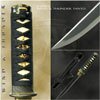
Wind & Thunder Wakizashi by Hanwei. This new cutting wakizashi from CAS/Hanwei is designed specifically for the martial artist that needs a sword for the demands of rigorous tameshigiri. The Wind & Thunder features a heavier and thicker blade with traditional furniture and fittings. The Wind & Thunder is fitted with the black iron Raiden tsuba and Tomoe motif fuchi and kashira. The handle is wrapped in genuine same (ray skin) and the tsuka-ito is premium Japanese black cotton. The saya is done in a traditional black laquer and the sageo is also black cotton. This sword is an excellent choice for those intereseted in batto-jutsu.
Thick & Heavy Blade
Hand-forged High Carbon Steel Blade
Great for Tameshigiri
|
|
|
|
|
|
 |
|
| Hanwei Wind & Thunder Tanto (SH5003) |
Points: 18
|
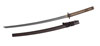
Each piece in the Wind & Thunder Set (SH5001 & SH5003) has a hand-forged 1065 high-carbon steel blade (nagasa) and is differentially tempered using a traditional claying method. The blades in the set feature a large o-kissaki. The Wind & Thunder Set is fitted with the black iron Raiden tsuba and Tomoe mon motif fuchi and kashira. The handle is wrapped in genuine ray skin (same) and the tsuka-ito and sageo are premium Japanese black cotton. The saya is done in a deep black lacquer and the sageo is black Japanese cotton. CAS/Hanwei have designed a cutting katana with thicker and heavier blades specifically for the martial artist that needs a sword for the demands of cutting the larger goza (tameshigiri). This set is ideal for those looking for a katana for the rigors of Battojutsu.
High-carbon steel blade
Deep black lacquer saya
Genuine ray skin
|
|
|
|
|
|
 |
|
| Hanwei Three Monkey Katana (SH2329) |
Points: 40
|
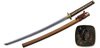
The "Three Wise Monkeys" is a popular symbol of the "See no evil, hear no evil, speak no evil" proverb popular in many cultures around the world. The proverb itself is thought to have originated in China and was brought to Japan by a Buddhist monk, while the association with three monkeys appears to be a Japanese play on words. Our Three Monkey Katana (SH2329) and Wakizashi (SH2330) are built on traditional Shinogi Zukuri style blades with Bo-Hi to reduce weight and improve balance. The high-carbon blade is hand forged and differentially hardened. The blackened iron Tsuba features the "Three Wise Monkeys" in relief.
|
|
|
|
|
|
 |
|
| Hanwei Bushido Katana (SH1210) |
Points: 50
|
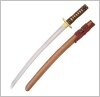
Each piece in the Bushido Series (SH1210, SH1211, & SH1212) has a hand-forged & folded K120C powder steel blade, differentially tempered using a traditional claying method to produce an HRC60 edge, HRC40 back. The temper line (hamon) is evident and prominent and the grain pattern (hada) shows distinct layers. The saya are deeply lacquered in gold with inlaid brass cherry blossom (sakura) flowers. High quality ray skin (same) is used on the tsuka of the katana and wakizashi, while the tsuka of the tanto is a gold-plated brass with a battle-scene decoration in relief. The tsuba of the katana and wakizashi is of blackened and bronzed iron, with detailing in gold and silver and a battle scene decoration. The tsuka-ito on the katana and wakizashi and the sageo on all three pieces are woven from premium Japanese cotton. The fuchi and kashira are of blackened bronze with brass detailing, and the kojiri, koiguchi and kurikata are of polished buffalo horn. The blade collar (habaki) is a one-piece brass construction. The katana and wakizashi blades are un-grooved, while the tanto blade is grooved (bo-hi) on both sides. The katana and wakizashi have medium-length (chu) kissaki. See Models SH1211 and SH1212 for the Wakizashi and Tanto details.
Hand forged and folded steel blade
High quality
Traditional construction
|
|
|
|
|
|
 |
|
| Hanwei Bushido Wakizashi (SH1211) |
Points: 30
|
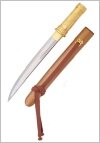
Each piece in the Bushido Series (SH1210, SH1211, & SH1212) has a hand-forged & folded K120C powder steel blade, differentially tempered using a traditional claying method to produce an HRC60 edge, HRC40 back. The temper line (hamon) is evident and prominent and the grain pattern (hada) shows distinct layers. The saya are deeply lacquered in gold with inlaid brass cherry blossom (sakura) flowers. High quality ray skin (same) is used on the tsuka of the katana and wakizashi, while the tsuka of the tanto is a gold-plated brass with a battle-scene decoration in relief. The tsuba of the katana and wakizashi is of blackened and bronzed iron, with detailing in gold and silver and a battle scene decoration. The tsuka-ito on the katana and wakizashi and the sageo on all three pieces are woven from premium Japanese cotton. The fuchi and kashira are of blackened bronze with brass detailing, and the kojiri, koiguchi and kurikata are of polished buffalo horn. The blade collar (habaki) is a one-piece brass construction. The katana and wakizashi blades are un-grooved, while the tanto blade is grooved (bo-hi) on both sides. The katana and wakizashi have medium-length (chu) kissaki. See Models SH1210 and SH1212 for the Katana and Tanto details.
Hand forged and folded steel blade
High quality
Traditional construction
|
|
|
|
|
|
 |
|
| Hanwei Bushido Tanto (SH1212) |
Points: 23
|
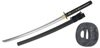
Each piece in the Bushido Series (SH1210, SH1211, & SH1212) has a hand-forged & folded K120C powder steel blade, differentially tempered using a traditional claying method to produce an HRC60 edge, HRC40 back. The temper line (hamon) is evident and prominent and the grain pattern (hada) shows distinct layers. The saya are deeply lacquered in gold with inlaid brass cherry blossom (sakura) flowers. High quality ray skin (same) is used on the tsuka of the katana and wakizashi, while the tsuka of the tanto is a gold-plated brass with a battle-scene decoration in relief. The tsuba of the katana and wakizashi is of blackened and bronzed iron, with detailing in gold and silver and a battle scene decoration. The tsuka-ito on the katana and wakizashi and the sageo on all three pieces are woven from premium Japanese cotton. The fuchi and kashira are of blackened bronze with brass detailing, and the kojiri, koiguchi and kurikata are of polished buffalo horn. The blade collar (habaki) is a one-piece brass construction. The katana and wakizashi blades are un-grooved, while the tanto blade is grooved (bo-hi) on both sides. The katana and wakizashi have medium-length (chu) kissaki. See Models SH1211 and SH1210 for the Wakizashi and Katana details.
Hand forged and folded steel blade
High quality
Traditional construction
|
|
|
|
|
|
 |
|
| Hanwei Ronin Katana (SH2360) |
Points: 50
|
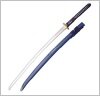
The Story of the 47 Ronin is one of the most celebrated and influential tales of the Samurai from the Edo period. Lord Asano was a powerful Daimyo ordered by the Shogun to entertain guests of the Imperial Family. The highest ranking master of protocol, Kira, was given the task of teaching Asano, among others, proper matters of etiquette in this task. Lord Asano and Kira quickly grew to dislike each other and the teacher insulted his student at every opportunity. No longer able to contain himself, Asano drew his sword upon Kira, wounding him in the attack. This act led to Asano's ordered suicide (seppuku) and the confiscation of his property. On December 14, 1702, nearly one year after Asano's death, 47 of Asano's men (now Ronin), descended upon the mansion of Kira to exact their revenge.
|
|
|
|
|
|
 |
|
| Hanwei Orchid Katana (SH1207) |
Points: 50
|
The Hanwei Orchid Katana is a Japanese sword designed by Paul Chen, featuring a hand-forged, folded K120C steel blade with a prominent hamon and layered hada. The tsuka is wrapped in genuine ray skin and premium Japanese cotton ito, while the blackened iron tsuba displays orchid and butterfly motifs inlaid with silver, brass and copper. The deep blue lacquered saya features buffalo horn fittings, and a matching wakizashi and tanto from the same Orchid series are available separately.
|
|
|
|
|
|
|
|
Tags:
swords, sword, katana, wakizashi, tanto, japanese sword, medieval sword, viking sword, japanese swords, medieval swords, viking swords, knife, knives, saber, armour, movie swords, movie replicas, martial arts, sporting goods, sporting equipment,
|



 - New items
 - Clearance sale
 - Discounted items
 - Add to favorites